skip to main |
skip to sidebar
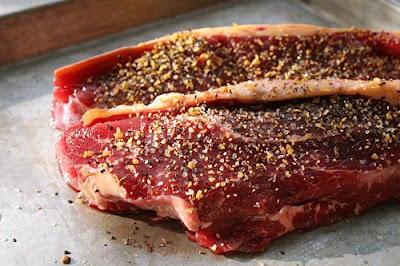 I picked up a free sample of McCormick & Co.'s Montreal Steak seasoning somewhere. I'm not exactly sure where I got it, either at a culinary festival or a culinary conference. I know that it was free because it says so right on the little packet.
We don't eat much beef around here anymore, despite my Texas upbringing, but I bought a couple steaks from a local Arizona cattle rancher at a farmers market a couple of weeks ago. Since I bought them (the young rancher looked so darn cute in his cowboy hat, I couldn't resist) I decided that I might as well grill them and use up the packet of free spice.
The Montreal Steak seasoning's first ingredient is salt. Normally, that would dissuade me from buying the spice. But the thing is, for steak, salt is probably the most important seasoning. You need salt and plenty of it to bring out the beefy taste (especially if the beef is grass fed, like these New York Strips).
Besides salt, there's a hefty amount of pepper - black peppercorns and red chile flakes. There are a few cracked coriander seeds and fennel seeds and lots of orange-tinted flakes that at first I thought might be orange peel. They're not. They taste hot. And garlicky. Maybe they're just granulated garlic but I'm not sure why they're orange.
If you grill a lot of steaks and you're always trying out a new spice mix, you might like this blend. Just be generous with it so it can live up to it's "bold" claim.
 Salt used to be good as gold. Or at least it was traded as currency in ancient civilizations. Now it's cheap and plentiful. We couldn't survive without salt in our diet. Like most things that are good for us, too much can be deadly...even sodium.
Recently, I picked up a spice mix at a swanky Texas market, a mix from a company based out of Boulder, Colorado. Now, I know most commercial spice mixes contain salt, and most are too salty, which is why I normally create my own blends. But this one was called orange pepper and salt was the third ingredient (U.S. food labeling laws require companies to list ingredients in order, by weight, beginning with the heaviest weight.)
Many prepared spice ingredient lists begin with salt. But I thought this one might not be too salty since salt was third. I was wrong. Now, if I had just sprinkled a whisper of this salty, orange pepper combination on my chicken breasts, I might not have noticed so much.
But I like to coat my protein in spice mixes for a full-on flavor blast, and I loved the idea of a peppery orange crust on my seared chicken. The dang thing was so salty, I'm sure it raised my blood pressure on the spot. I still like the idea of the orange pepper combination, so I've created my own blend (that does have a touch of salt, but not enough empty the coffers at Morton's.)
Gwen's Peppery Orange Spice Blend
Makes 1/4 cup
2 tablespoons freshly ground black pepper (coarse grind)
1 tablespoon freshly ground white pepper (coarse grind)
1 tablespoon dried orange peel
1 teaspoon dried lemon peel
1 teaspoon kosher salt
1 teaspoon sugar
1/2 teaspoon garlic powder
Stir all ingredients together and store in an airtight container. Recipe easily doubles. Use on chicken, turkey, or even fish.
 "Do you have any cardamom? Not ground but the whole pods," my friend asks as we're walking our dogs. I run through a mental picture of my spice cabinet, and land on the little bottle of green cardamom I bought a while back at Penzeys Spice Company.
"Yes, I do," I say, "but they're green, not black." She looks at me with a blank stare. My friend is not a prolific cook or baker, and she is constantly amazed at my tools, gadgets, and well-stocked pantry. "What's the difference, she says?"
And I couldn't answer her question, so I went hunting for the answer. Found it in the Field Guide to Herbs & Spices by Aliza Green. (Disclosure: I've met Aliza, and she's quite well known in the professional culinary circle as the field guide queen. She's also written guides on meat, seafood, and produce.)
Turns out that both green and black cardamom are used extensively in Indian cooking (think chai tea flavor as an example). Cardamom is also used in African, Middle Eastern and to a lesser degree, Chinese and Scandinavian cooking.
The green is more delicate in aroma and flavor than the black pods and black cardamom has a unique, smoky aroma and flavor as well. Green cardamom is also about three times as expensive as black cardamom, which would explain why I have green instead of black in my pantry. I tend to buy expensive things when it comes to the kitchen, thinking that it's better. Sometimes I'm right, other times not so much.
About an hour after our dog walk, I'm rummaging around in my pantry looking for the green cardamom pods when the phone rings. It's my friend and she tells me that she just returned from the grocery store and found black cardamom pods...on sale...half price, even. Instead of $14, she spent $7. If you knew how frugal my friend was, you'd laugh. She would NEVER spend that much money on a jar of spice. But she is determined to make these "Swedish Toasts" (Skorpa) that she describes as similar to biscotti, but thinner.
Now that she has her own cardamom, I'm not sure I'll get a sample of her Swedish treat, but I'm hoping that just the effort of looking for it, and reassuring her that using the black pods instead of the green pods won't cause any kitchen disasters, will be enough to encourage her to share. It is the sharing season, after all.



 Posts