skip to main |
skip to sidebar
 I just read a story about the top 10 dishes of Great Britain, and it got me thinking about what an American top 10 list would look like.
To be fair, our list has to be longer and not just because we're a nation of braggarts -- that would be a Texas list (and before you go all crazy on me, I'm from Texas and I say that with the utmost pride).
Geographically speaking, the USA is 38 times the size of Great Britain and population-wise, it's five times as large, ergo, we need a bigger list than just 10 dishes.
While I'm certain that I could come up with 380 dishes in a flash, in the interest of keeping your attention, I think I'll just rattle off 50.
To even begin talking about America's top dishes, you have to think both nationally and regionally. While it would be easy to list the top three as apple pie, hot dogs and ice cream, I want to delve a little deeper and pick dishes that not only define us as Americans, but ones that also reflect the melting pot that is our population.
We are a nation of immigrants. Only a few of us are descendants of Native Americans. Our foods are also reflective of this ethnic stew. Some of our foods are truly native: corn, beans and squash, for example. Others came with the Spanish (cows and pigs) and Africans (okra) and other settlers. Still others brought certain cooking techniques (the French and Germans specifically come to mind).
I'm not sure if 50 is long enough to reflect the diversity among our most recognized dishes, but it's a start. So, without further ado, here we go:
(drum roll, please)
50. Blackened redfish (thank you, Paul Prudhomme)
49. Root beer float
48. Pimiento cheese sandwich
47. Scrapple (although I'm not particularly fond of this, many, many Americans swear by it)
46. Frito pie (I'm particularly fond of this staple from my childhood)
45. Bundt cakes (any flavor, sour cream coffee cake is the most popular)
44. Green goddess dressing (over any kind of lettuce, perhaps romaine is traditional)
43. Chicken & dumplings
42. Maryland crab cakes
41. Whoopie pie (yippee!)
40. Jambalaya
39. Cioppino (San Francisco would be hurt if I left them out, they're sensitive that way)
38. Shoofly pie
37. Iceberg wedge with blue cheese dressing
36. Pecan sticky buns
35. Denver Omelet
34. Peach cobbler
33. New England clam chowder
32. Buttermilk pancakes
31. Brunswick stew
30. Philly cheesesteak
29. Chicken fried steak with cream gravy (don't forget the biscuits)
28. Fried rice (of course we fry the rice, we'll fry anything)
27. The Po'boy (oyster, shrimp or even roast beef for purists)
26. Shrimp & grits (I personally like the New Orleans style but the South Carolina version rocks, too)
25. Brown Betty
24. Cedar-planked salmon (Seriously? Only one Northwestern dish? I need to go to Portland)
23. Cobb salad
22. Meatloaf
21. King Ranch chicken casserole
20. Kansas City spareribs (notice I didn't say BBQ -- remember, I'm from Texas and we think we invented BBQ)
19. Succotash
18. Fried catfish
17. Soft shell crabs, fried of course
16. Black-eyed peas
15. Seafood gumbo
14.Wisconsin cheese soup
13. Collard greens (or mustard greens)
12. Grilled cheese (fancy schmancy or plain)
11. Mashed potatoes
10. Chicken pot pie
9. Bowl of chili (red, green, white or even Cincinnati-style with spaghetti)
8. Steamed Maine lobster
7. Chimichanga (yes, it was invented north of the border, although who was first is still in dispute)
6. Chocolate chip cookies
5. Mac & cheese
4. Shrimp cocktail
3. Southern fried chicken
2. Texas BBQ beef brisket
1. Turkey & dressing
...
(keep scrolling....)
...
(a little further...)
...
(almost there...)
...
(patience...)
0. The hamburger (had to include it -- it's my favorite)
 Guess my hand was shaking a bit while snapping this photo. Or, maybe it's just the natural sparkling glow of candied orange peel. Yeah, that must be it.
Making candied peel is a perfect weekend task. It takes a bit of work, but the result is worth it. Start with organic oranges, or if those aren't available, give the oranges a good scrubbing to remove the shiny wax they're sometimes coated with.
While you bring a big pot of water to boil, slice off a little of the top and bottom of 2 to 3 oranges, and then slice off the peel to the flesh. Cut the peel into 1/4-inch matchsticks. Set up a large bowl of ice water.
Gently boil the peel for a couple of minutes and then remove them with a slotted spoon to a bowl of ice water to stop the cooking. Do that two more times, blanching a total of three times.
Next, remove them to paper towels to dry, and scrape off most of the pith with a knife.
Pour 3 cups of sugar and 3 cups of water into a wide saucepan and bring just to a boil, stirring to dissolve the sugar. Stir in the dried orange sticks and cook until the sticks are tender, about 40 minutes. The mixture will reduce and thicken.
If you're so inclined, you can add a cinnamon stick, a star anise pod or two and/or whole cloves into the sugar water in the beginning to spice up the oranges.
Meanwhile, place another cup of sugar in a large bowl. Set a cooling rack in a sheet pan.
When the orange sticks are gooey-thick, remove with a slotted spoon and dump into the bowl of sugar and toss. Be very careful! The sugar syrup is extremely hot and you don't want to get any of it on you.
Space the sugared peels on the rack so they don't touch each other and let them dry for at least a day, maybe two.
Now, what to do with them? Eat them, of course.
Or dip one end in melted dark chocolate.
Or chopped them up and add to muffins or scones.
Or, wrap them in cellophane with a pretty bow and give to a friend.
Don't forget about the Great American Picnic this weekend! Saturday (noon to 10 p.m.) and Sunday (noon to 6 p.m.). Admission is $10, and tasting tickets cost $1 each.
The Scottsdale Civic Center Plaza will be swarming with foodies sampling tastes from 50 different restaurants, and imbibing in the vodka tent, the margarita tent or in the beer garden.
If you can only go one day, pick Sunday and arrive before 1 p.m. That's when the Challenge to the Chefs takes place, pitting four rockin' chefs against each other in a crazy, timed competition with a mystery basket of ingredients.
The competitors: Aaron May (Sol y Sombra, Autostrada, Over Easy); Jeff Smedstad (Elote Cafe, Sedona), Tim Fields (Sushi Roku) and Wade Moises (Pasta Bar).
The GAP is always fun, and this culinary showdown just sweetens the deal. It's going to be hot, hot, hot on Sunday, so slather on the sunscreen, wear something light and breezy and go support the festival. See you there!
 Trend: a line of general direction or movement.
I can't help but think that eggs on dinner menus is a rising trend.
The French and Spanish have served eggs for lunch and dinner for hundreds of years, so can it really be a trend if it's been around that long?
Apparently, we are just now catching on. Eggs are peppering the menus of some of the trendiest restaurants across the country. Here's just a sampling:
I tasted a smashing side dish at Zengo in Denver recently -- green beans sauteed with soy sauce and finished with scrambled eggs.
At L20 in Chicago, braised pork belly shares the plate with an egg, and York Street in Dallas serves duck three ways, garnished with a soft poached egg.
In Scottsdale, The Mission plates up arepas (open-faced sandwiches with cornmeal patties instead of wheat bread) with an optional topping of a fried egg.
At Christopher's, in the Biltmore Shopping Center in Phoenix, I had a lovely frissee salad topped with a gently poached egg and copious amounts of smoky bacon -- a classic French bistro dish, to be sure, but all of a sudden trendy again.
Take a look at the menu of your favorite restaurant. Do you spot an egg?
 Sometimes, the only thing to do is to escape to the kitchen, pick up a knife and get to work.
No matter what kind of day I'm having, holding that knife makes everything (and sometimes everyone) else disappear. Who wants to come into the kitchen with a mad woman wielding a knife?
There is something therapeutic about slicing mushrooms, an onion, or any other vegetable. I am at home in the kitchen.
Peace comes with the simple motion of rocking a knife to and fro on a wooden cutting board. The sun streams through the big picture window above the sink, casting a warm glow over the board, my hand and my knife.
Others might run a warm bubble bath to erase the stress of the day. I pick up a MAC Santoku.
 Once upon a time, there was a cozy little cafe called Dragonfly. It was owned by a lovely young woman, who poured her heart and soul into the cafe, not to mention all of her time.
Dragonfly became a huge success, garnering awards left and right by the local media, and that just made the owner work harder and harder. Eventually, she sold the cafe because it was consuming her life -- and her health.
A friend emailed me the other day to say that she had dined at Dragonfly (under the new owners) and it was no longer the same. I already knew that because a little over a year ago, I reviewed the cafe for the local paper. We lamented about the demise of the signature salad - roasted butternut squash -- and so, in tribute, I roasted some butternut squash this weekend, recreating the lovely flavors of this fantastic salad. Almost.
I didn't make a cognac vinaigrette to go over the salad, but instead made a maple sherry vinaigrette. Below is a method for roasting butternut squash. Once roasted, you can serve it warm, or let it cool and top a salad with it. Dragonfly Cafe's signature salad, in addition to the roasted butternut squash and red onions, had toasted walnuts, bacon, goat cheese and port soaked raisins atop baby greens. Just lovely.
Roasted Butternut Squash
2 pounds butternut squash, peeled and cut into 3/4-inch cubes
1 red onion, peeled and cut into similar size cubes
2 tablespoons olive oil
2 tablespoon maple syrup
Salt and freshly ground black pepper
Heat the oven to 400 degrees. Line a baking sheet with parchment paper or a silpat. Toss the squash and red onions with the oil and maple syrup. Season with salt and pepper. Roast for 20 to 25 minutes, stirring once, until squash is browned and the onion is tender.
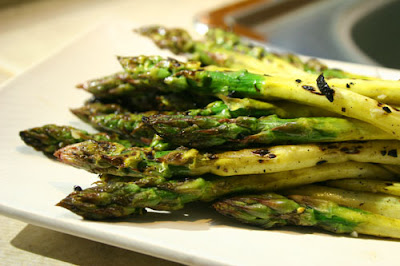 Certain ingredients define the season, and for me, asparagus means it's finally Spring. I love nothing better than grilled asparagus. You can serve it hot, straight from the grill, or serve it room temperature, or even chilled. Grilling imparts a haunting, smoky flavor while diminishing the grassiness of the Spring stalk.
I peel the stalks of thick asparagus for two reasons. My friend and culinary mentor, Barbara Pool Fenzl, insists that asparagus should be peeled. Credit her French training or her friend, Jacques Pepin, who also believes peeling is essential.
Peeling allows you to keep more of the stalk, which on thick asparagus can sometimes be woody near the end. It also makes a prettier presentation. Here's a recipe for grilling asparagus. I've used a lemon garlic marinade, but you can use any flavoring, or none at all.
Grilled Asparagus with Lemon and Garlic
Serves 6
1-1/2 pounds thick speared asparagus
2 medium cloves of garlic, peeled and minced
1/2 teaspoon Dijon mustard
zest and juice of 1 lemon
3 tablespoons olive oil (lemon flavored if you have it)
Salt and freshly ground black pepper
Trim asparagus to even lengths, then peel from just below the flowered tip. Place the asparagus in a shallow baking pan. Whisk together the remaining ingredients, and season with salt and pepper. Pour over the asparagus, tossing to coat. Marinate for 30 minutes up to 2 hours.
Heat the grill to medium-high (375-400 degrees). Drain the asparagus and discard the marinade. Place the asparagus on the grill. Grill for 3 to 4 minutes, moving the asparagus around a bit on the grill with tongs. Remove when the asparagus is still crisp tender, but shows signs of grill marks. Serve warm, or room temperature.



 Posts